Dead Animals
Dead animal and dead deer removal
A dead animal inside a house is fixed by finding and removing the carcass, then cleaning and disinfecting the spot, not by covering the smell. Georgia law makes the Department of Transportation remove carcasses from state highway rights of way, but a deer that dies in a yard or creek is outside that duty. T.A.C. Wildlife Solutions removes both across six north Georgia counties.
 Written and reviewed by Brandon Turley, owner and operator · Last reviewed
Dead animal calls come in two kinds. Outside, it is often a deer that was hit on a nearby road and died in a yard, a creek or a wood line, too heavy for most people to move and, since Georgia's 2025 chronic wasting disease detection, subject to a statewide disposal rule. Inside, it is a squirrel, rat, bird or other animal that died in a wall, attic or crawlspace, and the first thing anyone notices is the smell or the flies. Either way, the fix is the same: get the carcass out, dispose of it properly, and clean where it lay.
Signs of dead animals
- A bad smell that was not there before, strongest in one room, closet or stretch of wall
- Large, slow flies gathering at a window or light indoors, or maggots on the floor
- Scratching or movement in the walls or ceiling that suddenly stopped
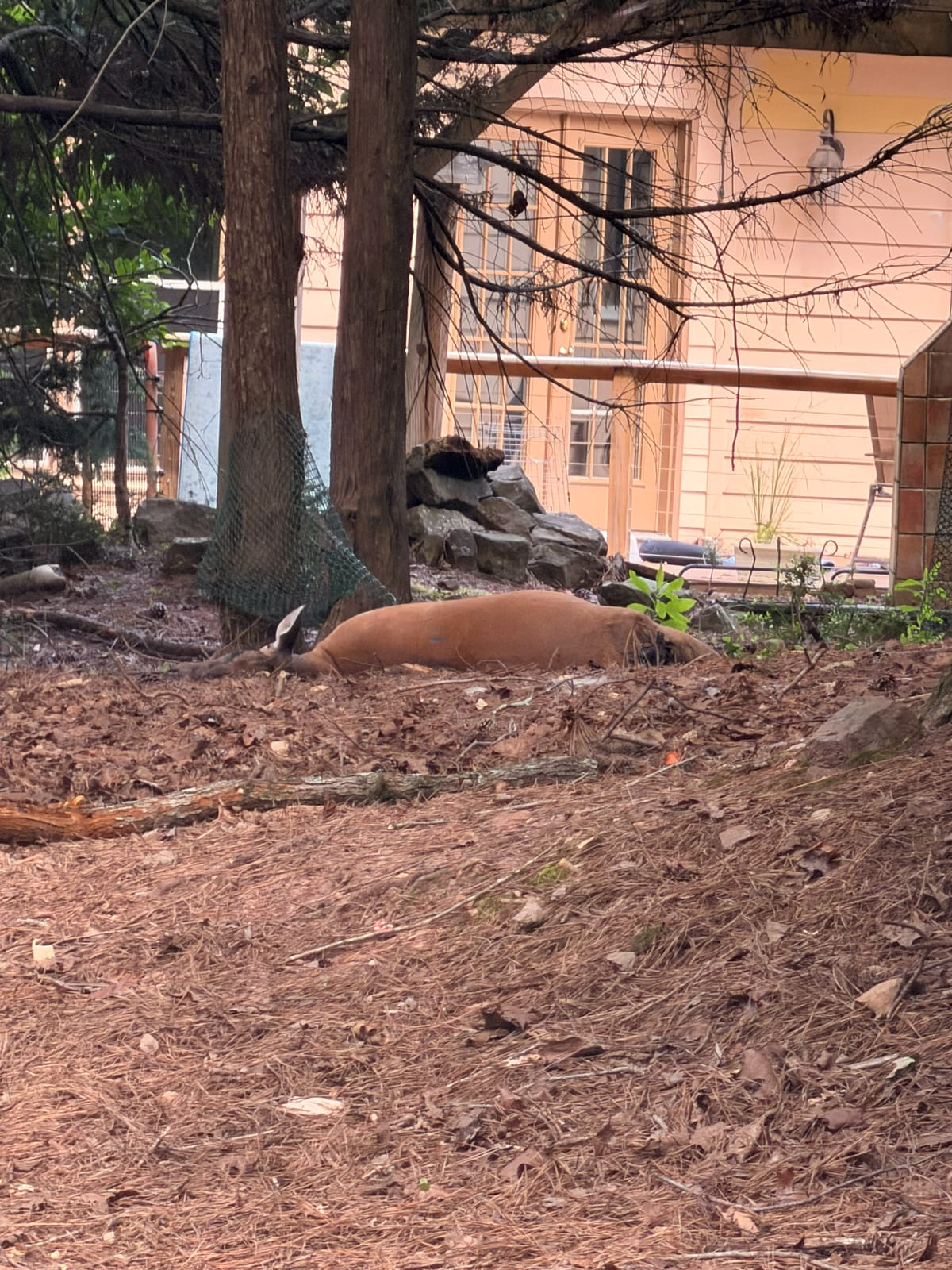
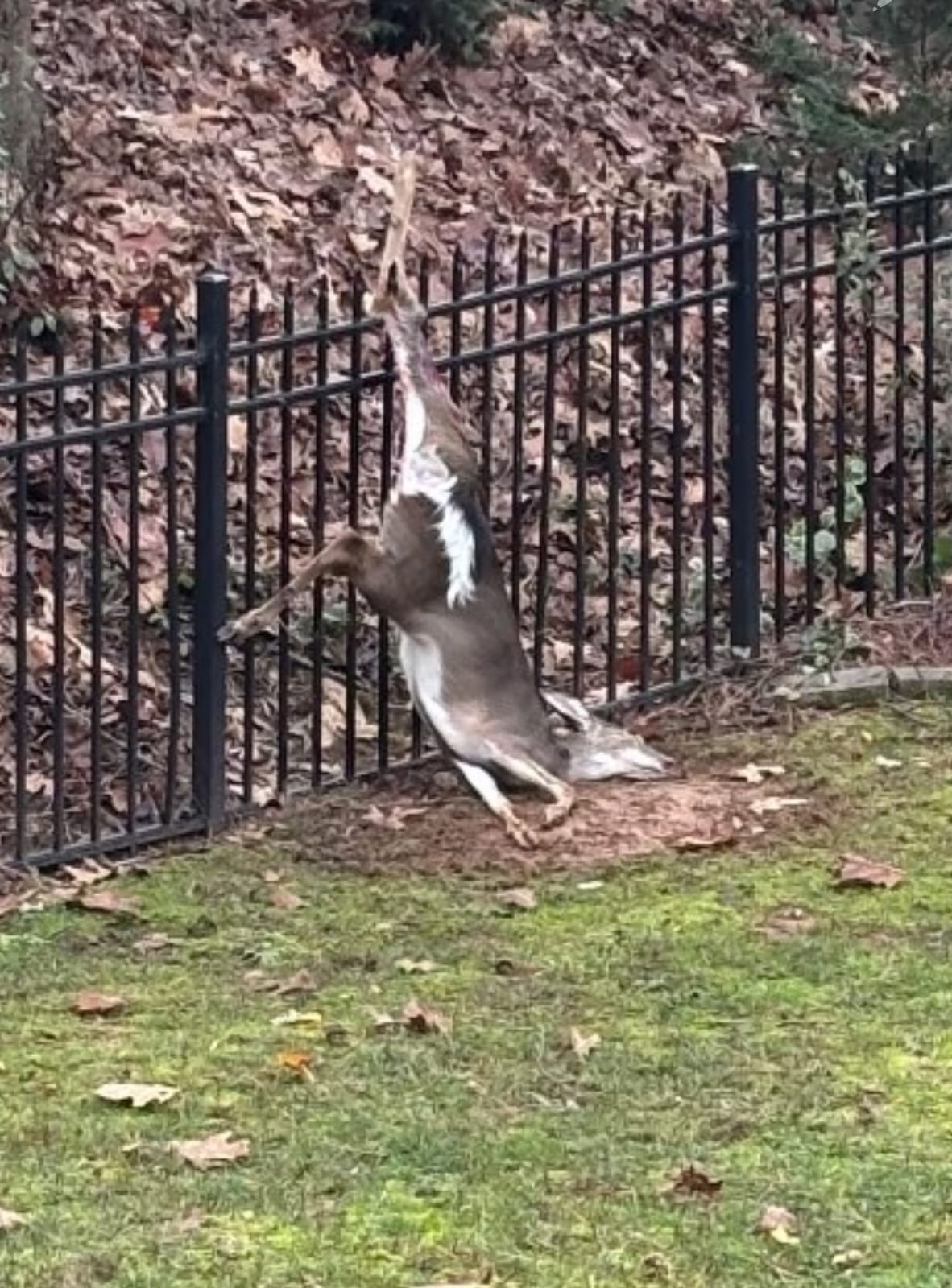
- A deer or other large animal lying in the yard, a creek, a ditch or along the wood line
How I handle it
Find the carcass
Outside, that is usually easy. Inside, I follow the flies, the smell and the signs of where the animal was living, checking the attic, the crawlspace, vents and the chimney before opening anything.
Remove it
I bag or wrap the animal and carry it out, whether it is a mouse in a wall or a full-grown deer at the bottom of a slope.
Clean and disinfect
Indoors, the spot is disinfected and anything that soaked up fluids, such as insulation or nesting material, is taken out. Outdoors, I make sure nothing is left to draw dogs or scavengers back.
Dispose of it properly
The carcass leaves with me and goes to disposal by an accepted method, never to a roadside or someone else's land. If the animal got into the house, I show you where it came in.
What customers say
4.9 on Google · 80 reviews-
★★★★★
Quickly removed a deer that died in our backyard after it was hit by a car in the neighborhood.
Bart C. · September 2026 · Google review
-
★★★★★
Brandon is honest and professional. He showed up the very next day as promised, and removed the dead deer. Several other companies gave me the run around, but Brandon was here the next day! I could not have asked for anything better! Saving your number for any future animal emergencies. 😊 Thank you! Thank you!!
Melinda R. · January 2026 · Google review
-
★★★★★
Found a dead deer in my yard. Called at 4:35 pm and Brandon promptly returned my call and said he could be at my home in 30 minutes. Brandon removed the deer at a reasonable price. I highly recommend Total Animal Control.
Alan P. · January 2026 · Google review
-
★★★★★
Excellent Same Day service! They responded quickly, removed the dead deer from my yard. Very professional and respectful. Highly recommend! Thanks again
C. S. · December 2025 · Google review
-
★★★★★
We had a dead fawn out back due to coyotes, ugh… Called Brandon with TAC Wednesday morning, and he completed the removal later the same day. Excellent service, thanks Brandon!!
Mike R. · September 2025 · Google review
-
★★★★★
TAC came out when they said they would-and were on-time the made quick work of the removal and were courteous and professional. Would recommend to anyone needing wildlife removal,dead or alive.
Jay C. · August 2025 · Google review
-
★★★★★
Brandon helped me get out of a tight spot by removing a deer carcass in the creek on my private property within smelling range of my house. One phone call and he was on site the next day. He called that morning with his ETA and was on time. Worked quickly, respectfully, professionally. Reasonable pricing. Definitely calling back if i need help again.
Randy C. · July 2025 · Google review
Reviews are copied word for word from Google. Older ones mention Total Animal Control, the company’s former name. Read all 80 reviews on Google
Who removes a dead deer from a state highway in Georgia?
On a state route, that job belongs to the Georgia Department of Transportation. Georgia law, O.C.G.A. section 4-5-4, makes it the department's duty to remove and dispose of carcasses found within the rights of way of state-maintained highways. That covers roads maintained wholly or partly with state funds.
The same section defines dead animals broadly, as the carcasses or parts of carcasses of all animals, whether or not they count as farm livestock. A deer, a dog or a raccoon on the shoulder of a state road all fall under it.
The duty stops at the edge of the right of way. A deer that was struck on a state road and then ran or was dragged into a yard, a pasture or a patch of woods is no longer sitting where the statute points.
What about a county road or a city street?
Section 4-5-4 speaks only to state-maintained highways. It says nothing about county roads or city streets, so the state highway rule is not the one to lean on there.
My advice is simple. If the animal is lying in a county road, call that county's road or public works department and ask. If it is inside city limits on a city street, call the city. Each local government sets its own policy, and the people who answer that phone are the ones who can tell you whether a crew will come.
If you cannot tell who maintains the road in front of you, the county office can usually tell you whether it is theirs, the city's or the state's. That one question saves a lot of being passed around.
Who deals with a deer that dies on my own property?
Once the animal is off the road and on private land, the state highway duty no longer reaches it. A deer that collapses behind a house, ends up in a fence line, or comes to rest in a creek on someone's land is not lying in a right of way. Unless your county or city offers pickup on private land, which is worth asking about, the property owner arranges removal.
This is the work I do: a deer in a back yard after it was hit on a nearby road, a carcass lying in a creek or a ditch on private property, a fawn left after a predator, or a deer that died beside a building where people gather. I come with what it takes to load and carry a full-grown deer, and I take it away for disposal.
Georgia's Department of Natural Resources now has a statewide rule on what happens to deer carcasses once someone moves or disposes of them. That rule is covered below, and it is the main reason a dead deer should not simply be dragged to the edge of the woods next door.
Can I keep a deer that was killed by a car?
In most cases, yes. Under O.C.G.A. section 27-3-28, any person may lawfully possess native wildlife that has been accidentally killed by a motor vehicle. White-tailed deer are native wildlife, so the general rule applies to them.
The statute has two exceptions. First, anyone who takes possession of a bear killed by a motor vehicle must notify the Department of Natural Resources or a law enforcement officer within 48 hours, giving the fact and location of taking possession along with their name and address. Second, the section does not authorize anyone to take possession of an animal of a species designated as protected under state law or federal law.
Keeping a deer is a choice, not an obligation. Nothing in that section requires the person who hit the deer, or the landowner where it lies, to take it. It only says possession is lawful.
Do I have to report a road-killed deer to anyone?
Section 27-3-28 sets a reporting duty for bears and no one else. It does not list a reporting requirement for a deer killed by a vehicle.
That does not mean the deer can go anywhere afterward. If you keep it, move it or get rid of it, Georgia DNR's carcass disposal rule applies the same as it would to a deer taken in hunting season.
There is one more case worth knowing. If the animal looked sick before it died, for example thin, drooling or acting strangely, Georgia DNR asks that sick deer be reported. How to do that is covered further down.
What does Georgia's deer carcass disposal rule require?
Georgia DNR states that proper deer carcass disposal reduces the risk of spreading chronic wasting disease to new areas, and that it is now required across all of Georgia. The rule applies to anyone transporting or disposing of deer carcasses or parts, including hunters, processors and taxidermists.
The department lists the accepted ways to dispose of a carcass or its unused parts. Anything outside this list is not on it for a reason.
- Leave them on the property where the deer was killed
- Use a commercial deer processor, which is required to dispose of unused parts properly
- Take them to a permitted solid waste landfill, as you would household garbage
- Bag smaller parts and put them in household garbage containers
- Deep burial, incineration, or another approved method in the Dead Animal Disposal Act, O.C.G.A. sections 4-5-1 to 4-5-11
Has chronic wasting disease been found in Georgia?
Yes. Georgia DNR says chronic wasting disease, or CWD, was first discovered in Georgia in January 2025. The disease affects deer, elk and moose. DNR describes it as always fatal, with no current vaccines or treatments.
To manage it, the department has set up a CWD Management Area. It covers the county with positive samples and any county touched by a five-mile radius around that location. As of this writing, DNR lists the management area as Atkinson, Lanier, Berrien and Lowndes counties.
Those are south Georgia counties. None of them is in Bartow, Cobb, Cherokee, Paulding, Floyd or Fulton County. That is not a promise about the future, and it is the reason the disposal rule now applies statewide rather than only near the known cases. The management area can change, so DNR's CWD page is the place to check the current list.
Can people catch chronic wasting disease?
Georgia DNR's guidance for hunters says CWD has not been shown to infect people, and it notes that there has never been a human case. It also passes along a recommendation from the Centers for Disease Control and Prevention: do not eat deer that test positive for CWD.
DNR encourages hunters who take deer inside the management area to submit them for testing, and the department contacts the hunter directly if a deer tests positive. Hunters outside the management area are not required to test, though DNR offers testing through connected processors, taxidermists and self-serve freezers.
None of that turns a dead deer in a yard into an emergency. It does explain why I treat every carcass as something to keep contained, bagged and out of the way of dogs and scavengers until it is gone.
What should I do if a deer looks sick before it dies?
Georgia DNR asks that questions about sick deer go to the regional Wildlife Resources Division office listed on its contact page. The department's CWD page also links an online form for reporting sick or dead wildlife, and it gives an email address for CWD questions, CWD@dnr.ga.gov.
Report what you saw, where, and when. A photo taken from a distance helps. Do not try to approach or handle a deer that is still alive and acting strangely.
If a deer has already died and you think it may have been sick, make the report before the carcass is moved or disposed of, and let the department tell you how it wants that deer handled.
How deep does Georgia require a buried animal to be?
The Georgia Department of Agriculture's dead animal disposal rules, Chapter 40-13-5, set out burial standards. A buried carcass must be at least three feet below ground level, but no more than eight feet, with at least three feet of earth over it.
The burial site has rules too. It must be more than 100 horizontal feet from existing or proposed wells and water supply lines, and 100 feet from the seasonal high water level of ponds, lakes, streams, tributaries or wetlands. It must sit in soil with moderate or slow permeability, at least one foot above the seasonal high groundwater level, and 15 horizontal feet from the edge of any embankment. Gullies, ravines, dry stream beds, drainage ways, sinkholes and the 100-year floodplain are excluded.
Who those rules are written for matters. The chapter defines dead animals as livestock, animals connected to licensed shelters, kennels, stables, pet dealers and bird dealers, animals processed by commercial facilities for human consumption, and animals tied to wildlife exhibitions. A wild deer in a yard is not on that list. DNR's deer rule, however, names deep burial under the Dead Animal Disposal Act as an accepted method, so these standards are the ones to meet if a deer is buried.
Can a dead animal be taken to the landfill?
For deer, Georgia DNR lists a permitted solid waste landfill as an accepted method, handled as you would household garbage. Smaller parts can be bagged and put in household garbage containers.
The Department of Agriculture's rules add some conditions for the animals they cover. No one may dispose of a dead animal in a city, county or licensed landfill without the landfill manager's permission, and a carcass accepted at a landfill must be covered by three feet of dirt the same day it is delivered. That is why calling the landfill first is part of the job, not an afterthought.
Those same rules forbid disposing of a covered animal on another person's land without the owner's permission. Dumping a carcass on a vacant lot, a neighbor's wood line or a roadside is not disposal.
What other disposal rules apply in Georgia?
For the animals it covers, Chapter 40-13-5 says no person shall abandon on any property any animals that have died or been killed. It also forbids abandoning dead animals in wells, open pits or surface waters, on private or public land.
For animals covered by the chapter, disposal generally has to happen within 24 hours of death or discovery. Carcasses sent to rendering must reach the rendering facility within 24 hours of death unless they are refrigerated or frozen.
When a dead animal is hauled, the rules call for covered or leak-proof containers, and commercial haulers need a written permit from the Department of Agriculture. I carry carcasses sealed and covered for the same practical reasons the rule exists: nothing leaks, and nothing falls out on the road.
How can I tell something died inside my walls or attic?
Flies are often the first clear sign. Iowa State University Extension describes blow flies and flesh flies as very common flies associated with dead animals. Seeing them, or their maggots, indoors usually means an animal such as a rodent or bird has died within the walls or in the attic.
A smell that was not there a week ago, strongest in one room, closet or stretch of wall, is the other common reason people call. If you heard scratching or movement in the walls or ceiling and then it stopped, that timing is worth mentioning too.
These signs point to a carcass, but they do not mark its exact spot. That is why I go looking rather than guessing from one room.
Why are maggots or big flies turning up inside the house?
It is the life cycle playing out. Iowa State Extension explains that these flies lay eggs in recently dead animals. The larvae feed on the carcass for 5 to 10 days, then leave it and wander off looking for a dry place to pupate. That is how maggots end up crawling across a floor or windowsill far from the carcass itself.
Maggots left to develop turn into adult flies in 5 to 7 days. Iowa State notes that the flies and maggots are harmless, and that they do not lay eggs or develop further inside the house, because by then the carcass is too dry.
For the maggots, the extension's advice is to vacuum or sweep them up and discard them, then check the walls, attic and similar spaces for the dead animal. Adult flies can be swatted or controlled with an indoor insecticide labeled for flies. Killing flies, though, does not touch the cause.
How do I find an animal that died in a wall, attic or crawlspace?
I start with where the animal was most likely living or traveling. The attic above the smell, the crawlspace below it, and the gaps around pipes and vents are where I look first.
Flies gathering at one window, light fixture or outlet help narrow the search. So do stains, droppings and trails in insulation. I also check the places people forget: bath and dryer vent runs, the space under a tub, soffit cavities, the chimney and the ductwork.
When the animal is inside a finished wall and cannot be reached from above or below, I make the smallest opening that will do the job, at the spot the evidence points to, and remove the carcass through it. Opening a wall is a last step, not a first one.
Why won't air fresheners or odor sprays fix the smell?
Because the smell is coming from the carcass, and spray does not remove a carcass. Covering an odor while the source is still in the wall only buys time, and the flies keep coming as long as there is something to feed on.
Removing the animal is the fix. Once it is out, I clean and disinfect the spot it was lying on and take out any insulation or nesting material that soaked up fluids. Odor control products come after that, if they are needed at all.
There is one more piece. An animal that died inside got in somewhere. If the gap it used is still open, the next one can follow it. I look for that entry and tell you what it would take to close it.
How should a dead animal be cleaned up safely?
For dead rodents, the Centers for Disease Control and Prevention lays out a clear method. Wear rubber or plastic gloves. Spray the dead animal, any nest and the area around it with disinfectant, and let it soak for five minutes or for the time on the product label. If you make a bleach solution, the CDC calls for 1.5 cups of household bleach in a gallon of water, mixed fresh each time.
Then put the animal and any nesting material, along with used traps, in a plastic bag, tie it shut, put that bag inside a second bag and tie it too. Place it in a covered garbage can that is emptied regularly. Wash your gloved hands with soap and water or disinfectant before taking the gloves off, then wash your bare hands with soap and warm water.
The CDC also warns against sweeping or vacuuming rodent droppings and nesting material, because that can put contaminated particles into the air. For homes and outbuildings, it recommends opening them up to air out for 30 minutes before cleaning starts. Fleas are common on rodents, so the CDC suggests an EPA-registered repellent such as DEET on clothing, shoes and hands.
Are dead birds in the yard a reason to call Georgia DNR?
Sometimes. Georgia DNR asks the public to report multiple dead vultures, crows, waterfowl such as ducks and geese, waterbirds such as cormorants, pelicans, herons and egrets, and shorebirds such as gulls, terns, sandpipers and plovers seen at a single site. It also asks for reports of individual dead or sick birds of prey: eagles, hawks, falcons, owls and osprey.
Reports can be made online at georgiawildlife.com/report-dead-birds or by calling 1-800-366-2661 or a local DNR office. For multiple dead songbirds or species not on those lists, DNR asks that you call instead of using the online link.
DNR's advice is not to handle wild birds that are obviously sick or found dead, and to keep pets away from them, though it notes that transmission to pets is rare. It cites the CDC's view that the current public health risk is low. Backyard poultry owners are directed to the Georgia Avian Influenza Hotline at (770) 766-6850.
What affects the cost of removing a dead animal?
I do not quote prices on a page, because no two of these jobs are alike. What changes the work is easy to name, though.
- Size: a mouse in a cabinet and a full-grown buck in a creek bed are different jobs
- Location: a yard is easier than a crawlspace, and a crawlspace is easier than a finished wall
- Access: steep ground, water, fences and tight spaces all add time and equipment
- Finding it: when the carcass is hidden, most of the work is the search
- Cleanup: soaked insulation, stained surfaces and disinfecting add to the job
- Disposal: where the carcass can lawfully go, and how far away that is
What happens when I come out for a dead animal call?
On the phone, I ask what the animal is, where it is lying, and how long it has been there. For a deer, I want to know about slope, water and gates, because those decide how it gets loaded.
On site, I find the carcass, bag or wrap it, and carry it out. Indoors, I clean and disinfect where it lay and remove anything contaminated. Outdoors, I check for anything left behind that would draw dogs or scavengers back to the spot.
The carcass leaves with me and goes to disposal by one of the accepted methods. If the animal got into the house somehow, I show you where and talk through closing it, so you are not calling about the next one.
Common questions
Do you remove dead animals from under houses and decks?
Yes. Crawlspaces, the space under a deck or porch, and the gap under a shed are all places I go into after a dead animal. I remove it and treat the spot it was lying on.
Do you take the animal away with you?
Yes. You are not left with a bag on the curb. The carcass leaves with me and is disposed of by one of the methods Georgia accepts.
Can I leave a dead deer in the woods behind my house?
If the deer died on your property, yes. Georgia DNR lists leaving a carcass on the property where the deer was killed as one accepted disposal method. Moving it onto a neighbor's land is not one of the listed options.
Can I bury a deer myself?
Deep burial is one of the methods DNR accepts. Follow the Department of Agriculture's standards: at least three feet deep and no more than eight, with three feet of earth on top, well away from wells, water lines, streams and ponds, and out of gullies, drainage ways and the floodplain.
Can I keep the antlers from a deer hit on the road?
Georgia law allows any person to possess native wildlife accidentally killed by a motor vehicle, with exceptions for bears and protected species. Whatever is not kept still falls under DNR's statewide carcass disposal rule.
What if I hit a bear?
Under O.C.G.A. section 27-3-28, anyone who takes possession of a bear killed by a motor vehicle must notify the Department of Natural Resources or a law enforcement officer within 48 hours, with the location and their name and address.
Does a dead deer on my property need a CWD test?
Georgia DNR encourages testing for deer taken inside the CWD Management Area, which is currently Atkinson, Lanier, Berrien and Lowndes counties. Outside that area testing is not required. If the deer looked sick, contact a DNR regional office.
Can I put a dead squirrel or rat in my outdoor trash can?
The CDC's method for dead rodents is to spray with disinfectant, double-bag the animal and tie each bag shut, then put it in a covered garbage can that is emptied regularly. Wear gloves and wash up afterward.
Should I vacuum maggots that show up on the floor?
Iowa State University Extension says the only control needed for flesh fly maggots is to vacuum or sweep them up and throw them away. The real fix is finding and removing the dead animal they came from.
I found one dead hawk in my yard. Should I report it?
Yes. Georgia DNR asks for reports of individual dead or sick birds of prey, including hawks, eagles, falcons, owls and osprey. Use georgiawildlife.com/report-dead-birds or call 1-800-366-2661, and do not handle the bird.
Will the smell go away if I just wait?
Iowa State Extension notes that by the time a new round of flies emerges, the carcass is too dry for them to breed in again, so it does run its course. Waiting means living with the odor and the flies in the meantime. Removing the animal ends both, and lets the spot be cleaned and disinfected.
Can a dead deer be pushed into a creek or ditch?
Do not do it. The Department of Agriculture's rules forbid abandoning the animals they cover in wells, open pits or surface waters, and water is not on DNR's list of accepted ways to dispose of a deer. A deer already lying in a creek should be pulled out and disposed of by one of those methods.
Where I do this work
Dead Animal Removal across Bartow County, Cobb County, Cherokee County, Paulding County, Floyd County and Fulton County, Georgia.